
When visited: August, 2003
When Established: December 18, 1971 – National Monument in 1937
Park ranking: 42 out of 63
Highlight: Red Rock landscape, Arches, Mesas, 100 mile Waterpocket Fold, Fossils, Petroglyphs and International dark sky park
Why not to go: If you don’t like the summer heat, sand, and/or desert
First off, a confession. I haven’t spent much time in Capitol Reef and that’s my fault. So why is it ranked so highly? Several reasons:
- Central and southern Utah’s red rock is one of the most beautiful places in the United States in my opinion. Utah ranks as my favorite state for scenery – hard to beat the red rock against a perfect blue sky
- As one enters the park one feels like you have entered a wild west movie or a science fiction scene or will soon see Thelma and Louise.
- Spirits live in this area – you can sense them.
- The concept of having an elevated reef in the middle of the desert is mind blowing – showing how much our planet has changed and will continue to change – Utah is one of the places where that comes to life for me.
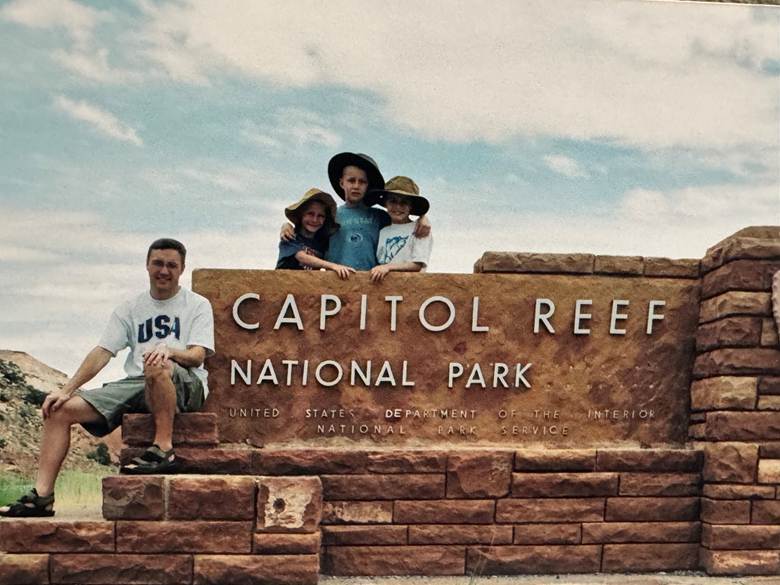
One of the earliest national parks we visited as a family in 2003
Capitol Reef National Park is in central Utah and is part of the Grand Circle of parks. The Grand Circle includes Arches, Canyonlands, Bryce Canyon, Zion, Mesa Verde, Capitol Reef and the Grand Canyon. I would advise the best time to do the Grand Circle would be October or April. Summer can be incredibly hot. Winter is also a good time to visit if you don’t mind it to be a little colder but pay attention to the snow forecast. (Note: fresh snow on the red rocks is spectacular!)
One should check the entry requirements to Zion, Arches and Bryce Canyon when planning a trip to those parks. Timed entry has become the norm for these parks in the busy season. The Grand Circle is a highlight of red rock scenery in the United States and Capitol Reef is in the center of the circle.
When reaching the park, it looks like it could be the surface of Mars – who would live here and how would one live her. Yet the park has been a homeland to people for thousands of years, becoming a homeland for the Fremont people. The Fremont Culture transformed into farming of corn, beans and squash – prior it was a nomadic group of hunters and gatherers that migrated through the canyon. Petroglyphs in rock walls tell the story of these ancient peoples. Of course, today’s culture is impacted by followers of the Church of Latter-Day-Saints who make their home throughout much of Utah. The Morman culture has created the Fruita Rural Historic District in the park where one can find fruit orchards and other agriculture.
Most of our time in the park was near the Waterpocket Fold by the Fremont River. This Fold is what gives the park its name, Capitol Reef. As part of the fold, one can find white domes of Navajo Sandstone that resemble capitol building domes. One can also find the 100-mile reef that includes rocky cliffs which have been and still are a barrier to travel.
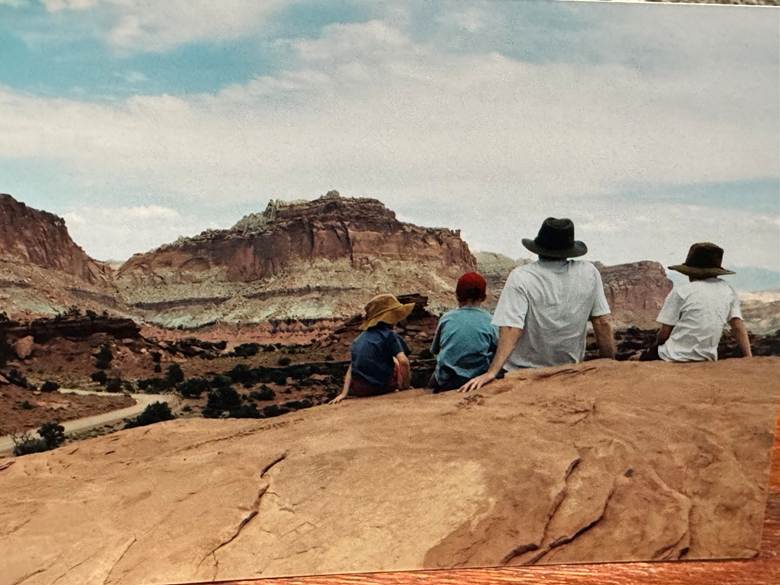
Gotta love the hats enjoying the beautiful scenery
The Waterpocket Fold is a 100-mile-long warp in the Earth’s crust. This occurred between 50 and 70 million years ago. Movement along the fault, caused the west side to shift upwards relative to the east side. The overlying sedimentary layers were draped above the fault. Over time erosion has shaped the fold and rock creating the cliffs, domes, canyons and spires that we see today.
Our drive through Capitol Reef was part of the Grand Circle tour in 2003. We flew into Las Vegas and began our drive to Arches National Park. Our kids were 8, 7 and 5 so we often broke up long drives with many stops. Our second planned stop that day was at Capitol Reef. We don’t have many photos of the visit, but I recall visiting the Fruita Valley where the Mormons had attempted civilization. We marveled at the fruit trees and the farming in the desert. I was mesmerized by the red rock, the white domes, the highway running through seemingly barren land but challenging us to continue to find adventure around the next bend.
We did a hike through a wash and examined an arch. We hiked through the natural bridge and further up the wash allowing the boys to rock scramble and get out some energy.
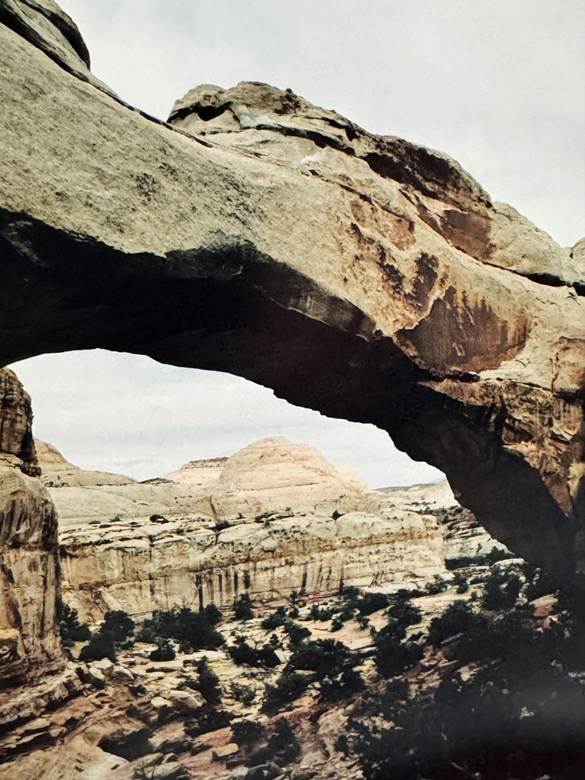
A Capitol Reef natural bridge
We still planned to travel that day to Arches so we were limited in time, which means I need much more time and explore the trails that we missed, drive the dirt roads and marvel in the beauty created by ions of time and changing climates.
Oh, and look for the big horn sheep, foxes, mountain lions and ringtails.
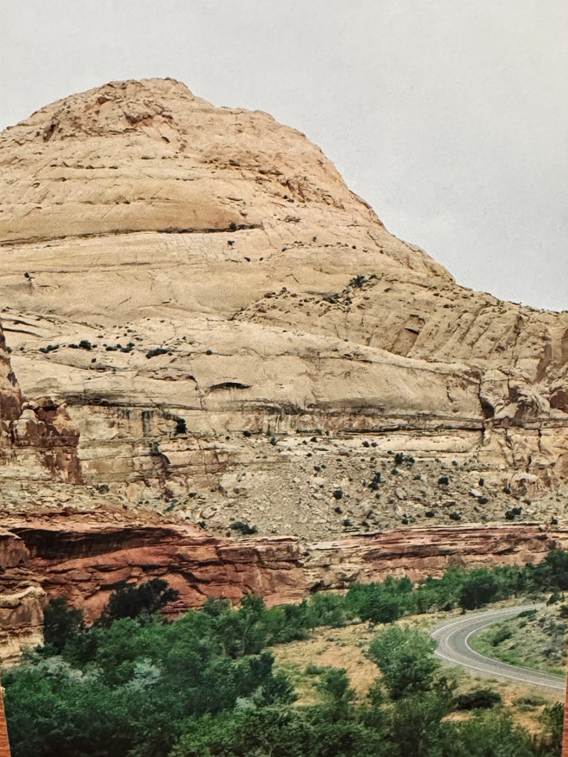
A white dome in Capitol Reef


Leave a Reply