
When visited: December, 2009 and as a child in the 1970s
When Established: June 15, 1934
Park ranking: 48 out of 63
Highlight: Mountains, Waterfalls and Salamanders
Why not to go: It is a highly visited park – one of the busiest in the national park system
Great Smoky Mountain National Park is located in Tennessee and North Carolina. It has three Visitor Centers (Cades Cove, Sugarlands and Oconaluftee). The Appalachian Trail splits the park into a north and south half and includes Clingmans Dome at 6,643 feet, Newfound Gap at 5,046 feet and Big Creek. Each visitor center is a launching point for an area of the park and visitors should consider Deep Creek and Big Creek sections of the park as well.
The park has elk, black bear, foxes, abundant birdlife and of course, salamanders. The park is known as the salamander capital of the world. The park also displays magnificent color during the autumn foliage season and beautiful wildflowers during the springtime. The NPS has also reserved many historical structures within the park.
The Smoky Mountains name comes from the Cherokee word, Shaconage, which means “place of the blue smoke”. This smoke is actually a naturally occurring haze caused by organic compounds released by the dense forest. From a distance this haze appears to make the mountains appear covered in smoke.
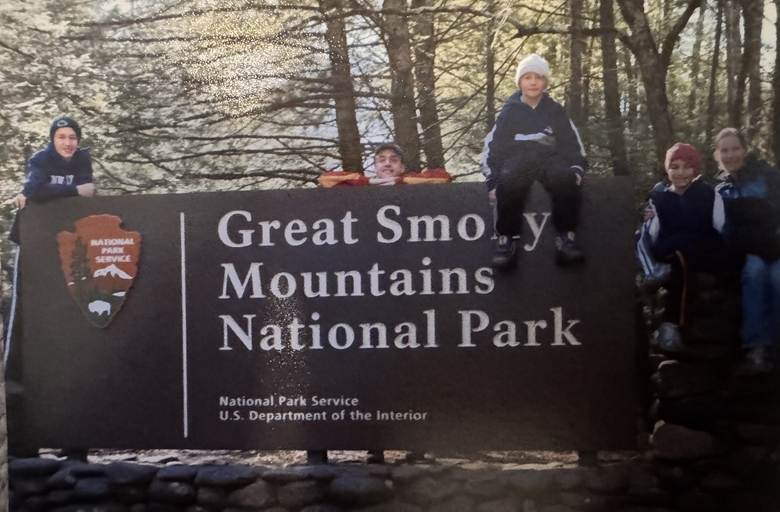
A family favorite – posing for a group photo with the sign in 2009
Our visit to the Great Smoky Mountains National Park was brief and in winter which reduced some of the things we were able to do. During the Christmas break of 2009-10, we decided to make a driving trip through southern US states that we had not visited on a quest to continue to work toward our goal of visiting all 50 states as a family. The trip included visits to Amicalola Falls in Georgia, Springer Mountain (the southern end of the Appalachian Trail), waterfalls in Alabama and the University of Alabama football stadium, New Orleans, Vicksburg National Battlefield in Mississippi and a National Forest in Arkansas. We had hoped to reach Hot Springs National Park, but we began to have some car trouble around New Orleans and that made us concerned to drive the extra distance.
Our first stop on the drive however was Gatlinburg, Tennessee and a visit to the Great Smoky Mountains National Park. I had been there in the 1970/80s with my aunts and uncles but didn’t have a great recollection of the park. In fact, as a child, I more fondly remember spending hours on the best waterslide I was ever on in Gatlinburg. Spending hours with my cousins there was priceless. So, my recollection of the Great Smoky Mountains National Park wasn’t vivid.
Our son, Matt had a love affair with waterfalls and this park is a great place to see them. We could have spent days in the park doing more waterfall hikes but our aggressive agenda didn’t allow us to do that. We were able to hike to Rainbow Falls and Mingo Falls (just outside the park) on two separate hikes.
Our time in the park was cut short by an unfortunate car incident. We hit a piece of metal in the roadway on Interstate 81 near Staunton, Virginia and blew out the front passenger tire. It was Saturday, the 26th of December and our only spare tire was a donut. This was less than ideal. We called Triple AAA and they were able to help us and we proceeded to Walmart to buy a new tire and a spare (lesson learned). This incident set us back about 4 hours and we were unable to make it to Gatlinburg until after dark. All Smoky Mountain activity would wait until the 27th.
Although Tennessee is in the “South”, don’t let anyone tell you that it isn’t cold in December. We awoke to van windows completely iced over, which allowed Matt to display his love for waterfalls on the window.

Van windows in December!
Our first activity was the 5.4 mile round trip hike to Rainbow Falls. We had the entire trail to ourselves and didn’t see any people. The trail follows a beautiful creek with many cascades and we ascended into the area of snow/ice. We didn’t have any yak traks for our shoes but they weren’t really needed. There is about 1,500 feet of elevation gain on the trail and according to web site, the trail is crowded in the summer and parking is often not available so consider the shuttle service.
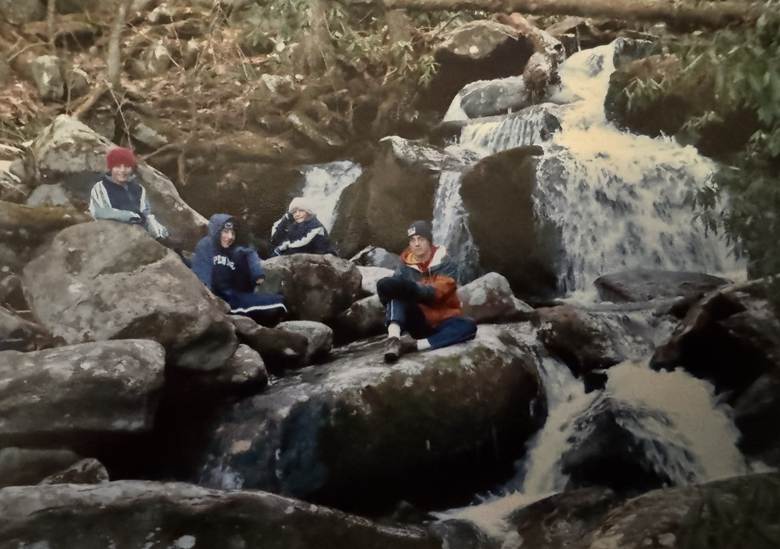
Relaxing for a break along the Rainbow Falls Trail
On our visit, we had none of those concerns – an empty parking lot and an empty trail. We marveled at the forest, the ice patches on the creek, light dancing off the ice and the moving water and relaxed. That is, until Scott slipped and twisted an ankle on the way down and claimed he was unable to proceed. That lead to my carrying him for the rest of the trail out and of course within an hour or two he was fine. Just saying….
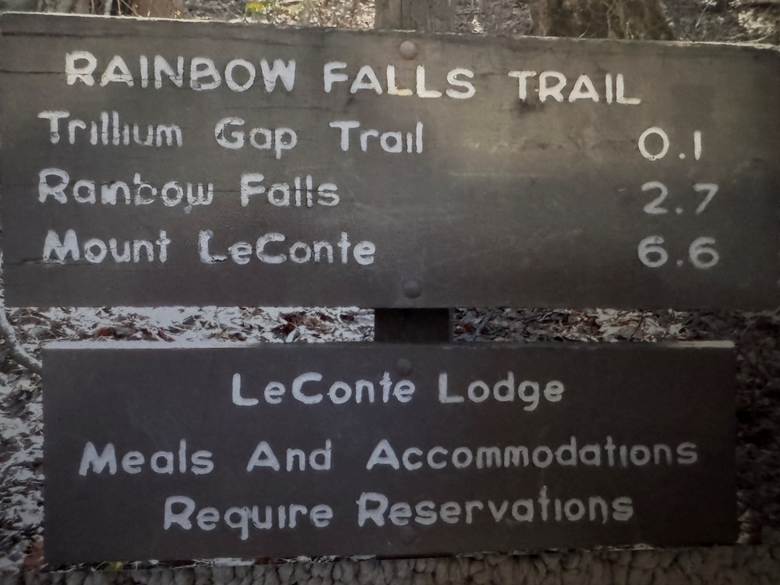
Rainbow Falls Trail sign with mileage
After our hike, we ventured to the Sugarlands Visitor Center and checked out the exhibits and bought the requisite park pin. Following the visit, we drove the Newfound Gap Road and crossed the North Carolina state line near Clingman’s Dome. We explored the Newfound Gap area a little and watched others throw snowballs and make snow people. Our sons didn’t miss an opportunity to join in the fun.
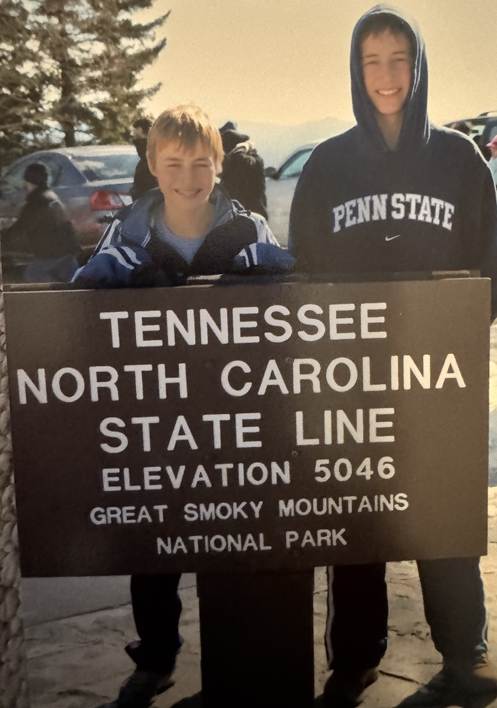
Finding the state line!
Our last activity near the park was to complete a short walk (.4 mile) to the 120-foot-high Mingo Falls in Cherokee, North Carolina. The falls are a short distance from the Oconaluftee Visitor Center and very worth the visit. It is one of the tallest waterfalls in North Carolina.
We finished out our day with a drive to Georgia to overnight at Amicalola Falls State Park. The Falls is 729 feet high and is one of the lesser-known waterfalls. We were impressed. The state park is also usually the launching point for through hikers heading north on the Appalachian Trail. It’s an 8.8-mile hike to the official start of the trail on Springer Mountain but there are no stores or hotels near it. One gets to the official start via Forest Service roads or hiking the 8.8 miles. We drove the forest road the next morning to find the start of the trail. We froze. It was well below freezing and the wind was strong. It was very cool to see the southern terminus of the trail but we weren’t dressed well enough to handle the cold wind for very long.
Winter is a fun time to visit Great Smoky Mountains National Park as it is less crowded. However, there are also limits to some of the activities. One of the activities that we couldn’t complete was to search for the rare salamanders that only exist in the park.
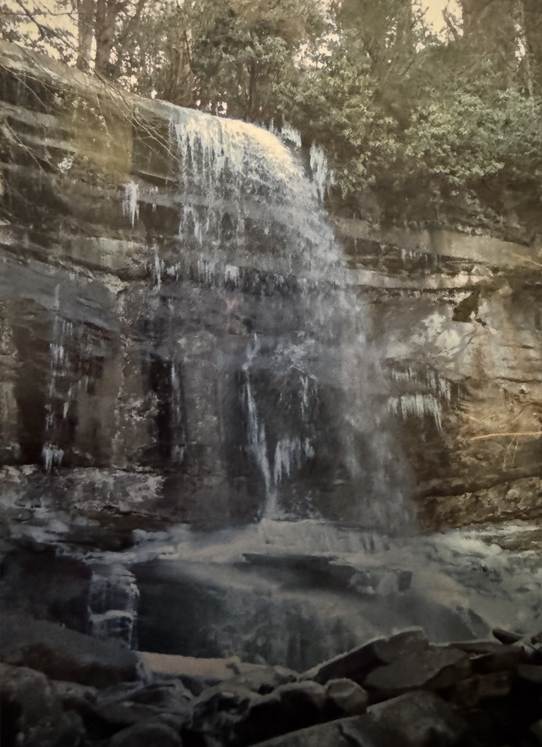
Winter Waterfalls!
Our time in Great Smoky Mountain National Park was brief which probably accounts for my ranking. I believe it should be a destination park where time can be spent exploring the waterfalls, searching for wildlife and learning the history. The following text from the NPS site sums up the park well.
“From black bears to salamanders, old-growth forests to spring wildflowers, log cabins to gristmills… the park offers a myriad of opportunities for exploring and discovering both the natural and cultural history of these ancient mountains. Great Smoky Mountains National Park covers 522,427 acres, divided almost evenly between Tennessee and North Carolina.”
We should definitely return in the spring or fall.
 We Visited All 63 U.S. National Parks
Leave a comment